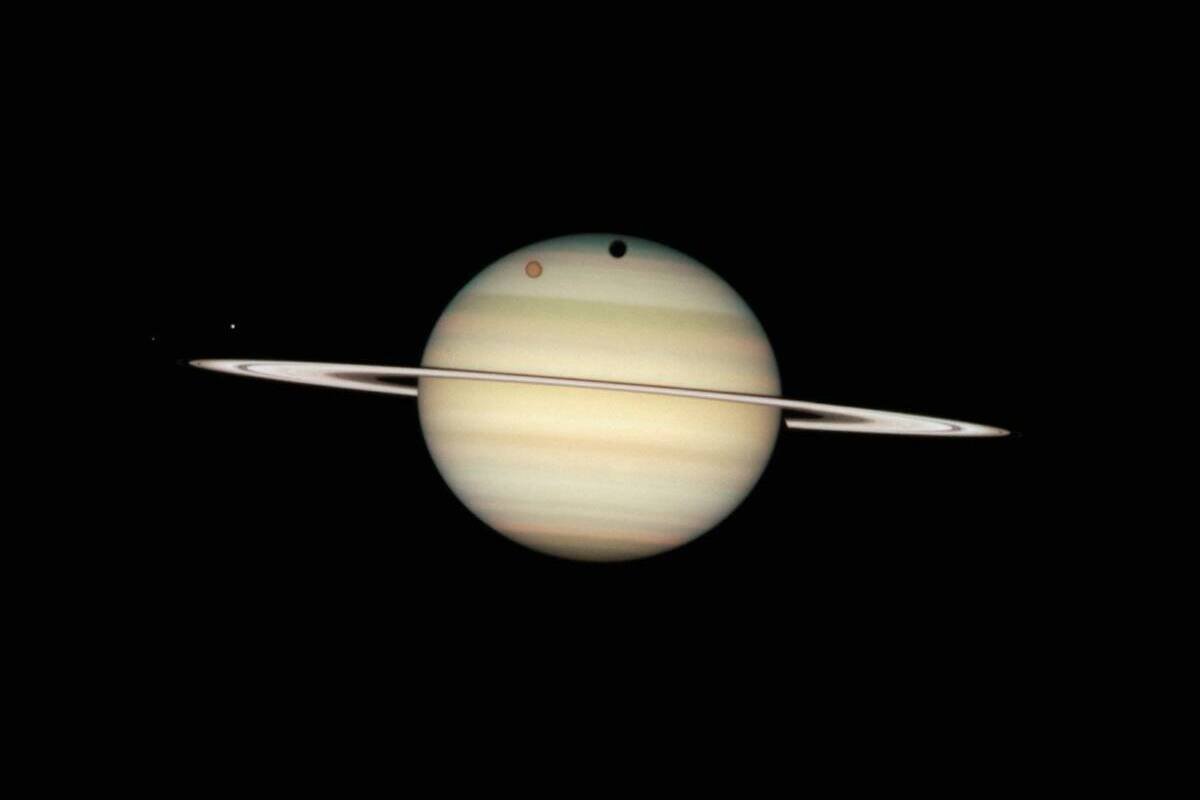
Saturn has had a signature look for 45 years: a six-sided hexagon swirling around its north pole, first spotted by NASA’s Voyager probes in 1980. Astronomers just found out the south pole has been hiding a trick of its own — a 10-sided decagon that appears to have formed within the last few years, right under everyone’s nose.
Found by Amateur Astronomers First
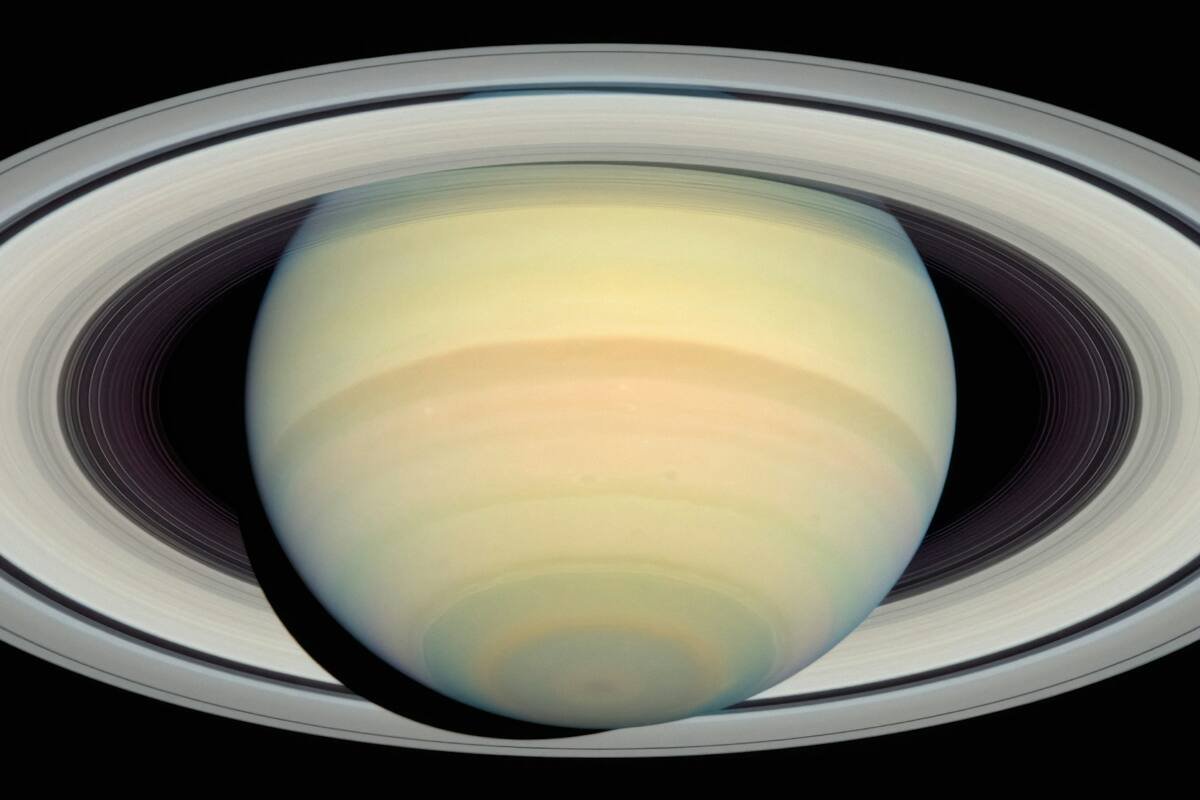
The discovery, published September 2 in Science Advances, started outside a professional observatory. In 2024, planetary scientist Agustín Sánchez-Lavega of the University of the Basque Country, working with amateur astronomers Trevor Barry and Jean-Paul Oger, noticed a faint, wavy band near Saturn’s south pole through the university’s Planetary Virtual Observatory Laboratory, a site that collects images from observers worldwide. Ground-based imagery through 2025 sharpened the picture into something unmistakable: ten distinct sides. Hubble Space Telescope observations then confirmed it and traced the feature’s presence back even further, to 2023 — just less defined at the time.
How Big Is It, Exactly?
The decagon spans roughly 104,250 miles (167,820 km) across, with each of its ten sides measuring about 10,425 miles (16,782 km) — for scale, that single side is longer than Earth’s diameter. It moves slowly, taking about 800 days to complete one full rotation around the planet, and Hubble data shows the feature extends through multiple layers of Saturn’s atmosphere rather than sitting as a thin surface pattern.
Why Nobody Saw It Coming
Saturn’s roughly 29-year orbit around the Sun means its poles only become visible from Earth for extended stretches every several years, as the planet’s seasons shift. The south pole had simply not been in good viewing position long enough for anyone to notice a slow-forming pattern like this — and unlike the north’s hexagon, nothing similar had ever shown up in decades of prior observation, including detailed imagery from NASA’s Cassini spacecraft. “The most intriguing part to me is that this seems to have just formed recently,” said Amy Simon of NASA’s Goddard Space Flight Center, a co-author on the study. “The question is, why did it suddenly form now when we haven’t seen one before?”
What This Means for the Famous Hexagon
For 45 years, Saturn’s hexagon has been treated as a genuine oddity — a geometric structure with no confirmed match anywhere else in the solar system. The decagon changes that framing entirely. “This discovery suggests that the hexagon is not as extraordinary as previously thought, and that, in fact, the conditions in Saturn’s atmosphere are such that polygonal waves can form in both hemispheres surrounding the polar regions,” Sánchez-Lavega said. In other words, Saturn may simply be a planet that produces polygon-shaped atmospheric waves as a matter of course — scientists just hadn’t had the right vantage point to catch the southern one until now.
Bottom Line
Researchers still do not know what triggered the decagon’s sudden appearance or how long it will last, and they are actively recruiting more observatories, including the James Webb Space Telescope, to watch it develop. Hubble is already scheduled to check back in on Saturn again later this month as part of its long-running OPAL program, which specifically tracks slow seasonal changes across the outer planets. For now, the takeaway is simple: after 45 years of studying one of the solar system’s strangest features, astronomers just learned Saturn had a second one hiding the whole time.